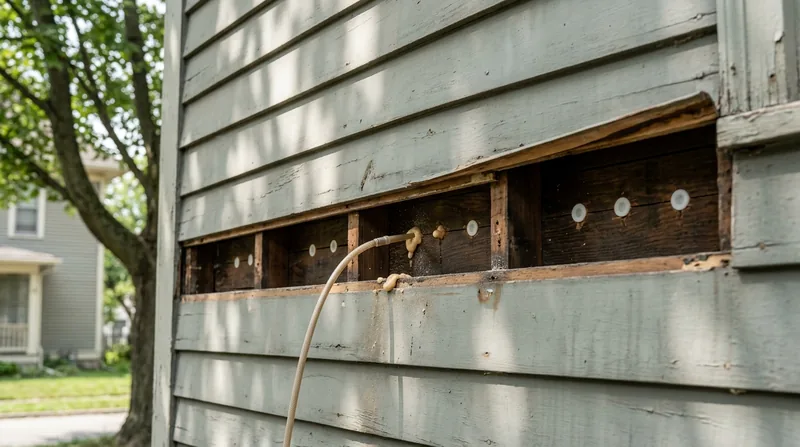




Wall & Injection Foam Insulation in Indianapolis fills the empty cavities inside the exterior walls of older homes without tearing out siding or drywall. Indianapolis is built on layers of architectural history: balloon-framed Victorian cottages and worker doubles from the 1870s through 1920s line the core neighborhoods like Irvington, Fountain Square, and Fletcher Place; 1910s-30s foursquares and bungalows fill Meridian-Kessler and Broad Ripple; post-war ranches on crawl spaces sprawl through Lawrence, Speedway, and Beech Grove. Almost none of these homes have insulation in their exterior walls. When January temperatures drop below zero and July humidity climbs to 80 percent, those empty cavities leak heat and allow moisture to drive through the rim and band joists into the basement or crawl space. Injection foam seals the wall cavity from inside, stops the air leakage, and controls vapor movement without demolition. It is the retrofit answer for the Indianapolis frame house.
Why Wall & Injection Foam Matters in Indianapolis Older Homes
Indianapolis has more than 100 years of uninsulated frame construction. The balloon-framed cottages and doubles of the inner core were built when heating fuel was cheap and air leakage was accepted as normal. Post-war ranches on crawl spaces followed the same pattern: exterior walls framed with no cavity insulation, relying on interior baseboard heat and closed doors to manage comfort. In climate zone 5, with winter lows below zero and summer humidity swings, uninsulated walls drive three problems at once: steady heat loss in winter, moisture accumulation in spring and fall, and cold interior surfaces that feel drafty even when the furnace is running. Injection foam fills those cavities and stops all three.
- Heat loss through empty walls accounts for 15 to 25 percent of total home heat loss in uninsulated frame construction.
- Moisture condenses on the inner surface of the rim joist and band joist in spring, feeding mold and decay in basement rim boards.
- Air leakage around rim and band creates cold drafts at the floor line and allows soil gases to enter crawl spaces.
- Injection foam seals the cavity and stops convection without requiring exterior demolition or interior drywall removal.
These problems are not cosmetic. A rim joist that rots because of chronic moisture will eventually fail structurally, and the cost to replace it is five to ten times the cost of injection foam. Getting ahead of the problem is the only smart move.
Key info: Indianapolis building code (adopted from the current International Energy Conservation Code) requires that spray foam insulation be covered by a thermal barrier rated for fifteen minutes of fire protection. For walls, this is typically the drywall finish on the interior side. Injection foam into existing cavities is governed by the code in force at your address and by the local building official. Before any work begins, verify with your city or township building department whether a permit is required and what thermal barrier rules apply to your wall cavity.
For more on the science of moisture and air sealing in Indianapolis homes, see our air sealing service page.
How Injection Foam Insulation Works: The Indianapolis Process
Injection foam is a retrofit method that does not require demolition. A technician locates the wall cavity by tapping and listening, then drills small holes (typically 1.5 to 2 inches in diameter) through the exterior siding, either under a course of clapboard or along a mortar joint in brick. The foam gun is inserted, and low-pressure injection fills the cavity from bottom to top. Once cured, the holes are patched with matching trim or caulk. The entire exterior wall remains intact, and the interior drywall is never touched. In Indianapolis, where homes sit close together on narrow lots and many are listed on historic registers, this no-demolition approach is often the only acceptable method.
- We drill access holes through the siding at regular intervals, typically 16 to 24 inches apart vertically.
- The injection foam is metered at the manufacturer-specified ratio and temperature to ensure full expansion and cure.
- Mechanical ventilation runs during and after injection to manage VOC off-gassing during the cure period.
- After twenty-four to forty-eight hours, holes are patched with foam-core trim or color-matched caulk.
- The exterior finish remains unchanged, preserving the historic character of the home or the curb appeal of the property.
This step-by-step approach means the job can be completed in one to two days for a typical Indianapolis cottage or bungalow, and the home is fully re-occupied within forty-eight hours of completion.
Local example: A 1920s two-family double in Fountain Square with a brick exterior and two stories of uninsulated walls will typically require 400 to 600 board feet of closed-cell injection foam. Holes are drilled along the mortar joints, foam is injected into each cavity, and the mortar is repointed. The entire exterior remains brick, and the interior is untouched. Homeowners report noticeably warmer walls and no more condensation on the rim joist by the second winter.
For context on how injection foam fits into a broader retrofit strategy, see our closed cell spray foam service page.
Injection Foam Methods and Applications
| Method | Description | Best For |
|---|---|---|
| Closed-Cell Injection | High-density foam injected into cavities at low pressure; expands to fill voids and cures rigid; R-value approximately 6.0 to 6.5 per inch. | Exterior walls of older homes; rim and band joists; moisture-prone cavities; vapor control in climate zone 5. |
| Open-Cell Injection | Lower-density foam injected into cavities; expands to fill and cures spongy; R-value approximately 3.5 to 4.0 per inch; permeable to vapor. | Interior wall cavities in conditioned spaces; sound dampening; retrofit where closed-cell may be cost-prohibitive. |
| Rim and Band Joist Injection | Closed-cell foam injected into the rim joist cavity and band joist area from inside the basement or crawl space; seals the largest air leak in most older homes. | Basements and crawl spaces in post-war ranches; moisture control; basement temperature stability. |
| Retrofit Cavity Fill | Injection foam used to top up or replace failed original insulation in existing wall cavities; drilled access does not require siding removal. | Homes with settled or degraded original insulation; balloon-frame walls; historic preservation projects. |
Wall & Injection Foam Insulation Cost in Indianapolis: What to Expect
Injection foam insulation is priced per board foot of material installed, measured on site by the technician. The cost reflects the density of the foam, the linear footage of wall cavity, the height of the walls, and the access method. Indianapolis homes vary widely: a modest 1950s ranch with 1,200 square feet of exterior wall and single-story height will require fewer board feet than a three-story Victorian with 2,500 square feet of wall surface. Labor includes hole drilling, injection, cure management, and patch work. Most injection foam jobs in Indianapolis range from $2 to $4 per square foot of wall area, or roughly $3,000 to $8,000 for a typical single-family home. A two-family double or a larger colonial will cost more.
Several factors move the price up or down. Brick exteriors require careful drilling along mortar joints and repointing, which costs more than drilling through clapboard siding. Walls with existing insulation (settled cellulose or fiberglass) take longer to fill and may require partial removal first. Access difficulty, such as a home surrounded by mature trees or situated on a narrow lot, can increase labor time. The type of foam (closed-cell is denser and costs more than open-cell) also affects the total. Historic homes in districts that require exterior matching or architectural review may have additional constraints.
The best way to understand cost for your home is to request a written estimate. We provide a free estimate with R-value and thickness specifications so you know exactly what you are paying for. For more detailed pricing information, visit our pricing page.
Wall & Injection Foam Insulation Near Me: What Indianapolis Homeowners Should Know When Hiring
Hiring a spray foam contractor is a significant decision, and it pays to verify credentials and get multiple estimates. Before you call anyone, understand what the local building department requires. Indianapolis and each surrounding municipality have their own permitting rules for spray foam insulation, and there is no reciprocity between cities. A contractor who works in Carmel or Fishers must also be compliant in Indianapolis, and vice versa. Call your city or township building department to ask whether a permit is required for wall injection foam at your address, and what thermal barrier or ignition barrier rules apply. This information tells you whether a contractor is working legally and whether they understand local code.
When you contact a contractor, ask for the following:
- A written estimate that includes R-value per inch, thickness, total board feet, and the specific foam type (closed-cell or open-cell).
- Proof of current liability insurance, with limits appropriate to the scope of work.
- References from recent jobs in Indianapolis or nearby suburbs, with permission to contact them.
- A clear statement of the re-entry window (typically twenty-four to forty-eight hours) and mechanical ventilation during cure.
- Explanation of how holes will be patched and whether exterior finish matching is included in the price.
Avoid any contractor who provides an estimate with no R-value or thickness, promises immediate re-entry or no ventilation during cure, or quotes a price far below market without inspection. These are markers of poor workmanship and undersized insurance. If your home is in an HOA community or a historic district, verify with the architectural review board before work begins. For questions about permits or to discuss your specific home, contact us for a free estimate.
Wall & Injection Foam Insulation in Indianapolis: Pricing Guide
| Service | Price | Details |
|---|---|---|
| Single-story exterior wall injection (1,200-1,500 sq ft wall area) | Starting at $2.50/sq ft | Typical for post-war ranches in Indianapolis; includes drilling, closed-cell foam, and standard patch work |
| Multi-story wall injection (2,000-2,500 sq ft wall area) | Starting at $2.75/sq ft | Two-story homes, foursquares, and Victorian cottages; height and access complexity drive labor increase |
| Brick or mortar-joint drilling (per linear foot of cavity) | Starting at $3.50/sq ft | Historic homes and masonry exteriors require careful drilling and repointing; materials and labor are higher |
| Rim and band joist injection (crawl space or basement access) | Starting at $1,500 to $3,000 | Small-ticket entry point; typical Indianapolis basement or crawl space rim joist, one to two days labor |
| Travel and estimate | Included within Indianapolis | No mileage fee or travel surcharge for jobs in Indianapolis and surrounding service areas |
| Free written estimate | No charge | Response within 24 hours at (463) 285-8584; includes R-value, thickness, board feet, and material type |
Indicative pricing, the exact cost depends on square footage, finish, and site access. Free personalized estimate within 24h at (463) 285-8584.


