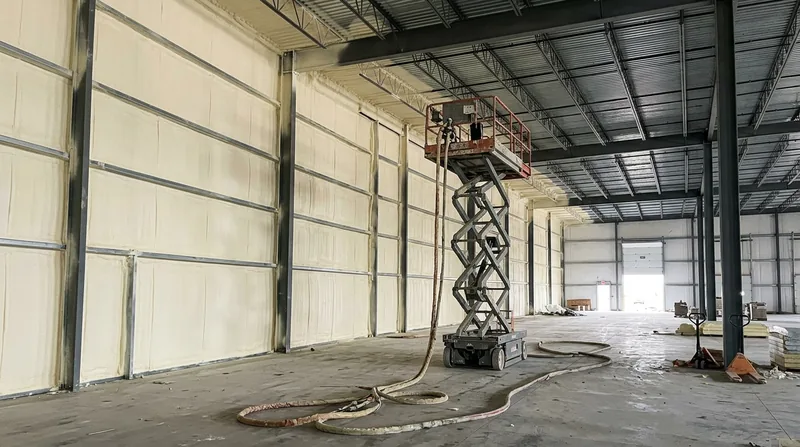




Commercial and new construction spray foam insulation in Indianapolis demands more than a trailer and an afternoon. The Plainfield logistics corridor, Whitestown distribution centers, and the steady stream of two-story residential builds across Carmel, Fishers, Noblesville, and Westfield all require code-compliant assemblies, on-schedule phased work, and documentation that your local building inspector will actually accept. We have served warehouses, offices, churches, and production builders since 2012 with the kind of precision that keeps your operation running and your certificate of occupancy on track. This is not rig-and-run work. This is insulation that performs, installed to spec, with the paperwork to prove it.
Why Commercial and New Construction Spray Foam Matters in Indianapolis
Indianapolis sits in climate zone 5 with real cold, real humidity, and real vapor drive that flips with the seasons. A warehouse shell in Whitestown that leaks air at the rim board in January will sweat at the metal panels in spring. New construction in Hamilton and Boone County demands tight assemblies from day one, not repairs after the warranty expires. Commercial buildings and production facilities cannot afford the downtime of moisture problems, condensation on steel, or energy loss that turns a tight margin into a loss.
- We spray closed cell foam to seal metal building condensation before it starts, locking out the seasonal vapor drive that rusts steel and rots wood.
- We build thermal barriers and ignition barriers that pass your local building code and come with the inspection documentation your building official requires.
- We work on your schedule, phasing work around active production or occupancy so your business does not stop.
- We remove failed or contaminated insulation and replace it with assemblies that will not fail again under Indianapolis climate conditions.
The difference between a compliant spray foam job and a failed one is measured in R-value, thickness, cure time, and mechanical ventilation during installation, not in price alone.
Key info: Indianapolis building code requires thermal barriers and ignition barriers on all spray foam insulation. Your local building department sets the standard for your address. We provide written estimates with R-value and thickness specifications so your inspector knows exactly what to expect. Verify requirements with your city or county building department before any work begins.
For more on the technical requirements of sealed assemblies, see our closed cell spray foam page, which covers the vapor control and condensation resistance that commercial buildings require.
How We Execute Commercial and New Construction Spray Foam in Indianapolis
Commercial and new construction work demands coordination. We schedule around your occupancy or production timeline, confirm permits and code requirements with your local building department before we arrive, and deliver documentation that satisfies your inspector and your insurer. Every job starts with a site survey, an estimate with R-value and thickness for each assembly, and a clear scope so there are no surprises.
- We confirm what your local building code requires for thermal barriers, ignition barriers, and ventilation for your specific assembly.
- We deliver a written estimate with R-value, thickness, and board footage for each zone so you know what you are paying for.
- We stage the job so work does not interfere with your operation or occupancy.
- We spray at the correct ratio and drum temperature, with mechanical ventilation running during cure and a documented re-entry window.
- We provide the inspection documentation and thermal barrier certificates your building department and insurance carrier require.
A warehouse shell in Plainfield, a church addition in Greenwood, or a production facility in Whitestown each has different code requirements and occupancy constraints. We treat each one as its own project, not as a volume number.
Example: A metal building retrofit at a distribution center near Whitestown requires closed cell foam to stop condensation on the steel roof deck and rim board. We remove any contaminated insulation first, spray the foam at the manufacturer ratio, run mechanical ventilation for 24 to 48 hours, and deliver the thermal barrier certificate and inspection report so the building official signs off. That is how a commercial job gets done right.
See our metal building and barndominium spray foam page for details on sealed roof decks and condensation control, or our insulation removal page if your commercial space needs old or failed insulation taken out first.
Commercial and New Construction Spray Foam Methods and Assemblies
| Approach | Description | Best For |
|---|---|---|
| Closed Cell Spray Foam | High-density foam with R-value 6 to 7 per inch, vapor barrier, and structural rigidity. Requires thermal and ignition barriers per code. | Metal building roof decks, rim boards, condensation control, structural adhesion, and assemblies with seasonal vapor drive. |
| Open Cell Spray Foam | Lower-density foam with R-value 3.5 to 4 per inch, vapor permeable, and lighter weight. Requires thermal and ignition barriers per code. | Interior cavity walls, vaulted ceilings, sound dampening, and new construction where vapor permeability is acceptable. |
| Rim Board and Band Joist Sealing | Closed cell foam applied to seal the perimeter junction between foundation and structure, stopping air leakage and moisture ingress. | New construction basements and crawl spaces, retrofit air sealing, and cold floor remediation in existing commercial buildings. |
| Cavity Wall Injection Foam | Low-pressure injection of closed or open cell foam into existing wall cavities without demolition. Fills empty voids in pre-1980 construction. | Retrofit insulation of brick or frame commercial buildings, warehouses with hollow walls, and additions over existing structures. |
Each method is selected based on the building envelope, the climate zone, the code requirements at your address, and the performance goal. There is no one-size-fits-all spray foam job in Indianapolis.
Commercial and New Construction Spray Foam Cost in Indianapolis: What to Expect
Commercial and new construction spray foam pricing in Indianapolis depends on the scope of the assembly, the access to the work area, whether existing insulation must be removed first, and the complexity of the thermal barrier and ignition barrier installation. A warehouse shell is priced differently than a retrofit of an existing facility. A new construction build-up is different from adding insulation to an occupied building. We start with a free commercial estimate that includes R-value, thickness, and board footage so you know what you are paying for and what the final assembly will perform like.
Closed cell spray foam typically runs higher per board foot than open cell because of its density, R-value, and vapor barrier properties. The Indianapolis climate, with its sub-zero winters and humid summers, often justifies closed cell for metal buildings and commercial shells where condensation control is non-negotiable. Open cell is an option for interior cavity walls and new construction where the vapor drive is managed by the overall envelope design.
Factors that move the cost up or down include tree size (board footage), access difficulty, whether old insulation must be removed, the presence of moisture or contamination that requires remediation before foam is sprayed, and whether the work must be phased around active occupancy or production. A single-story warehouse in Plainfield with clear access and no removal is a straightforward bid. A retrofit of an occupied office building in Indianapolis with multiple phases and occupied zones requires more coordination and takes longer.
Get two or three estimates from contractors who can articulate the R-value and thickness they are proposing, who explain the thermal barrier and ignition barrier requirements for your code, and who can show you the inspection documentation they will provide. Avoid any estimate with no R-value, no thickness, and no explanation of what the final assembly will be. That is how you end up with spray foam that does not meet code or does not perform.
For a detailed breakdown of our pricing structure and what is included at each level, visit our pricing page.
What to Look for When Hiring a Spray Foam Contractor Near Indianapolis
Hiring the right spray foam contractor is about more than price. You are looking for someone who understands your local building code, who can deliver documentation that your inspector will accept, and who will show up and do the work the same way every time. The Indianapolis market has both national franchises and local independents, and each has a different approach to permitting, scheduling, and accountability.
A contractor who is fully insured can show you a current certificate of insurance and the coverage limits for your project. Ask for references from commercial or new construction projects similar to yours in Indianapolis, Carmel, Fishers, or Noblesville. Check whether the contractor has experience with your local building department and can explain what permits and inspections apply to your job. Ask what thermal barrier and ignition barrier system they propose and why it meets your code. Request a written estimate with R-value, thickness, and board footage for each zone. Get at least two estimates so you can compare not just price but scope, specification, and the contractor's knowledge of your code.
- Verify that the contractor is fully insured and can provide a current certificate of insurance for your project.
- Ask for written estimates that include R-value, thickness, and board footage for each assembly, not just a per-board-foot price.
- Check references from commercial or new construction projects completed in Indianapolis or your surrounding area within the last two years.
- Confirm that the contractor understands the thermal barrier and ignition barrier requirements in your local building code.
- Ask whether the contractor will provide inspection documentation and thermal barrier certificates so your building official can sign off.
- Avoid any contractor who promises immediate re-entry, who does not mention mechanical ventilation during cure, or who cannot explain the manufacturer ratio and drum temperature.
The local independent contractor who has been in business in Indianapolis since 2012, who knows the building departments in Carmel, Fishers, Noblesville, and Greenwood, and who can walk you through the code requirements for your specific address is worth the phone call. Contact us for a free estimate at (463) 285-8584.
Commercial & New Construction Spray Foam in Indianapolis: Pricing Guide
| Service | Price | Details |
|---|---|---|
| Free Commercial Estimate | Free | Site survey, R-value and thickness specification, board footage calculation, code requirements review, written proposal, no obligation |
| Closed Cell Spray Foam (per board foot) | Starting at $1.50 | High-density insulation with vapor barrier, structural rigidity, condensation control for metal buildings and sealed roof decks |
| Open Cell Spray Foam (per board foot) | Starting at $0.85 | Lower-density cavity insulation, vapor permeable, interior walls and sound dampening, new construction and retrofit applications |
| Insulation Removal (per board foot) | Starting at $0.25 | Contaminated, failed, or old insulation taken out before spray foam is applied, bagged and disposed, area prepped for new foam |
| Phased or Complex Commercial Job | On Estimate | Occupied buildings, multiple phases, coordinated scheduling, moisture remediation, or non-standard assemblies require on-site assessment |
| Travel and Mobilization | Included | No separate mileage fee or travel charge within Indianapolis and surrounding service areas including Carmel, Fishers, Noblesville, Westfield |
Indicative pricing, the exact cost depends on square footage, finish, and site access. Free personalized estimate within 24h at (463) 285-8584.


