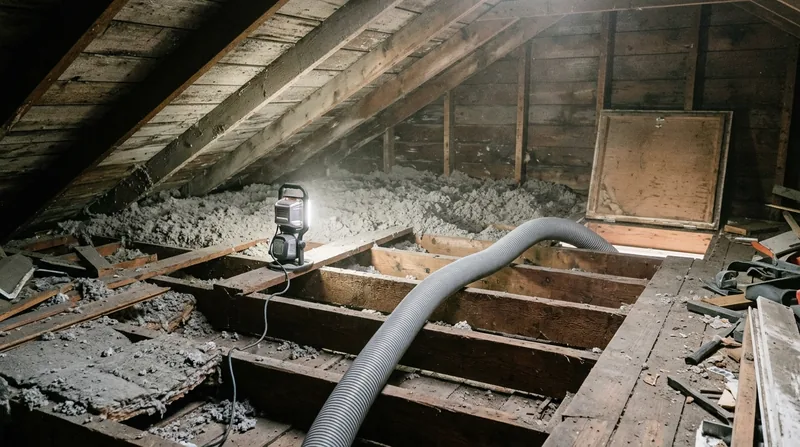




Indianapolis attics and crawl spaces accumulate decades of failed insulation, compacted batts, and deteriorated blown-in fiberglass that no longer performs. Before any new spray foam goes in, that old material has to come out cleanly and completely. Insulation removal in Indianapolis is the precondition of every retrofit, and it is work most installers avoid because it is messy, labor-intensive, and demands precision to avoid cross-contamination of the new foam. We remove everything that should not be there: old batts, blown-in fiberglass, failed spray foam from past jobs, and we flag vermiculite for testing because it may contain asbestos. Indianapolis homes split between balloon-framed Victorians around the loop with empty wall cavities and flattened attic insulation, 1950s ranches with cold crawl spaces and failed original batts, and new construction bonus rooms over three-car garages with vaulted assemblies that bake at 130 to 150 degrees Fahrenheit in July and drop below zero in January. Every retrofit starts with removal. We also handle the job that most installers will not touch: cutting out spray foam that has failed, shifted, or was installed too thick and now blocks ventilation or creates moisture traps. A free estimate begins the conversation. Call (463) 285-8584 to schedule.
Why Insulation Removal Matters in Indianapolis Attics and Crawl Spaces
Old insulation loses its R-value over decades, especially in Indianapolis climate zone 5 where sub-zero winters and humid 90-degree summers stress every assembly. Fiberglass batts compact and settle, blown-in material gets moisture-logged or contaminated by animal nesting, and failed spray foam from past jobs sits there blocking air flow or trapping condensation. You cannot spray new foam over wet, contaminated, or compromised substrate. The job fails. We remove the old material, assess what is underneath, confirm the substrate is sound and dry, and then build the new assembly right.
- We vacuum out all blown-in fiberglass and cellulose before any foam is applied, leaving a clean cavity.
- We cut out failed spray foam from prior installations, a specialty most shops will not perform.
- We identify and flag vermiculite in older Indianapolis attics for testing by a licensed professional, never disturb it.
- We document the substrate condition and any moisture or contamination so you know what you are starting with.
- We haul away all debris so your attic or crawl space is ready for the new assembly.
Removal done right is the foundation of a retrofit that performs and lasts. Without it, new foam sits on a failing base and inherits the same problems.
Key info: Indianapolis attics built in the 1950s and 1960s often contain original fiberglass batts that have settled to half their thickness and now sit above ceiling joists in Irvington, Fountain Square, and Lawrence. Blown-in fiberglass from 1990s retrofits in Carmel and Fishers frequently compacts and moisture-logs by year 15. Both situations require complete removal before any spray foam retrofit can be specified or installed.
For detailed guidance on what qualifies as safe insulation work in your Indianapolis neighborhood, consult the Indianapolis Department of Metropolitan Development building permits and inspections page, which governs what applies at your address.
How We Remove Old Insulation and Prepare Your Attic or Crawl Space
Removal is a four-step process that starts with understanding what is already there. We inspect the attic or crawl space, identify the material type and condition, check for moisture, animal activity, or contamination, and then plan the safest and most efficient removal method. In Indianapolis older homes, we often find a mix of materials: original batts, blown-in fiberglass from a prior retrofit, and sometimes failed spray foam from a job that did not cure properly or was applied too thick. Each requires a different approach. We use mechanical ventilation during the removal process, contain dust and debris, and haul everything away so your space is clean before we spray.
- We inspect the attic or crawl space and identify all insulation materials, moisture sources, and structural condition.
- We set up mechanical ventilation and containment to protect the rest of the house during removal.
- We vacuum out or hand-remove all old insulation, batts, blown-in fiberglass, and failed foam.
- We assess the substrate (roof decking, joists, rim boards, or floor) for moisture, mold, or damage and flag anything that needs repair before new foam is applied.
- We haul away all debris and leave the space ready for new spray foam or other work.
This deliberate approach prevents cross-contamination and ensures the new assembly starts on solid ground. Most installers skip steps or bury old material under new foam, which is how failed retrofits happen.
Example: A 1970s ranch in Beech Grove had original fiberglass batts that had settled and compacted over 50 years, plus blown-in cellulose added in the 1990s that had moisture-logged from a slow roof leak. We removed everything, identified and flagged the roof leak for repair, assessed the decking, and then specified closed-cell spray foam to handle the moisture risk and seal the assembly. The homeowner went from ice dams every winter and cold floors to a stable, sealed attic.
Learn more about insulation replacement and re-insulation to understand the full retrofit process after removal is complete.
Removal Methods and Best Applications
| Approach | Description | Best for |
|---|---|---|
| Vacuum removal | Industrial vacuum with hose and collection bin pulls loose blown-in fiberglass or cellulose from the attic. | Blown-in fiberglass or cellulose in accessible attics with no moisture damage or contamination. |
| Hand removal | Batts are cut and pulled by hand, placed in bags, and hauled away. Used when fiberglass is wet, contaminated, or when vacuum would damage the substrate. | Compacted or wet batts, crawl spaces with limited headroom, attics with active moisture or animal nesting. |
| Foam cutting and removal | Failed or improperly applied spray foam is cut out with hand tools or oscillating saws, piece by piece, and removed. | Failed spray foam from prior jobs, foam applied too thick, foam blocking ventilation, or foam over wet substrate. |
| Substrate assessment and repair | After removal, the decking, joists, or rim boards are inspected for moisture, rot, or structural damage and flagged for repair before new foam is applied. | Any retrofit where the substrate condition is uncertain or where prior insulation has masked damage. |
Insulation Removal Cost in Indianapolis: What to Expect
Insulation removal pricing in Indianapolis depends on the square footage of the space, the type and condition of the material being removed, accessibility, and whether the substrate requires repair or remediation. A straightforward attic vacuum removal of blown-in fiberglass starts at around $950 for a small to mid-sized attic. Hand removal of compacted batts or removal of failed spray foam runs higher because it is more labor-intensive and time-consuming. Crawl space removal is also more labor-heavy due to confined space and the need for mechanical ventilation. Access matters: an attic with a full-size hatch and good headroom costs less than one with a small opening or knee walls. If the substrate is wet or contaminated, additional drying or prep work adds cost.
The best approach is to get a free estimate on site so we can see the actual scope. We measure the area, identify the material, assess the condition, and give you a firm price before any work begins. Most Indianapolis homeowners find it smart to get 2 to 3 estimates so they can compare scope, method, and price across contractors. We offer a written estimate with no obligation.
Key info: A 1,200 square foot attic with settled fiberglass batts in a Broad Ripple foursquare typically costs $1,200 to $1,600 to remove by hand and haul away. The same attic with loose blown-in material vacuumed out runs $950 to $1,200. A crawl space removal in a Lawrence ranch with 800 square feet of compacted batts over a damp rim board may run $1,400 to $1,800 because of the confined space and the need to assess and dry the rim before any new foam is applied.
For a detailed pricing overview and factors that influence your estimate, visit the full pricing page.
Insulation Removal Near Me: What to Look for When Hiring a Spray Foam Contractor in Indianapolis
When you are looking for a contractor to remove old insulation and prepare your attic or crawl space for new spray foam, several things matter. First, verify that the contractor is fully insured and carries liability coverage in case something goes wrong on your property. Ask for proof of insurance and confirm the policy is current. Second, get multiple estimates so you can compare scope, method, and price. A written estimate should describe what is being removed, the square footage, the removal method, what happens to the debris, and any prep or repair work recommended. Third, ask for references from recent jobs in Indianapolis, Carmel, Fishers, or nearby areas, and call them. Fourth, understand what permits apply at your address by checking with your local building department. Some Indianapolis neighborhoods have HOA rules that govern exterior work, and older homes in Irvington or Meridian-Kessler may have architectural review requirements. Finally, understand that removal is only the first step. The real value comes from what happens next: a properly specified spray foam assembly that handles Indianapolis climate zone 5 winters and summers.
- Confirm the contractor is fully insured with current liability coverage and ask to see the certificate.
- Get a written estimate that describes the removal method, square footage, debris disposal, and any substrate prep or repair.
- Call references from jobs in Indianapolis or nearby suburbs completed in the last 12 months.
- Ask how the contractor handles vermiculite if found, and confirm they flag it for testing and do not disturb it.
- Understand the timeline: removal typically takes one to three days depending on attic or crawl space size and material condition.
- Ask what happens if the contractor finds moisture, mold, or structural damage during removal, and confirm they will stop and advise you before proceeding.
A contractor who takes time to inspect, plan, and communicate scope is the one worth hiring. Removal done right is the foundation of a retrofit that performs.
Ready to get started? Contact us for a free estimate at (463) 285-8584. We respond within 24 hours and will schedule an inspection at your convenience.
Insulation Removal in Indianapolis: Pricing Guide
| Service | Price | Details |
|---|---|---|
| Blown-in fiberglass removal | Starting at $950 | Vacuum removal of loose fiberglass in accessible attics up to 1,200 square feet with no moisture or contamination |
| Batt removal and hand haul | Starting at $1,200 | Hand removal of compacted batts or wet fiberglass, typical for 1950s and 1960s Indianapolis homes with settled original insulation |
| Failed spray foam removal | Starting at $1,400 | Cutting out and removing failed spray foam from prior installations, specialty work most contractors will not perform |
| Crawl space removal | Starting at $1,300 | Hand removal in confined spaces with mechanical ventilation, typical for 800 to 1,200 square feet over damp rim boards |
| Travel and estimate | Included | No mileage fee or travel charge within Indianapolis and surrounding areas, free written estimate with no obligation to book |
Indicative pricing, the exact cost depends on square footage, finish, and site access. Free personalized estimate within 24h at (463) 285-8584.


