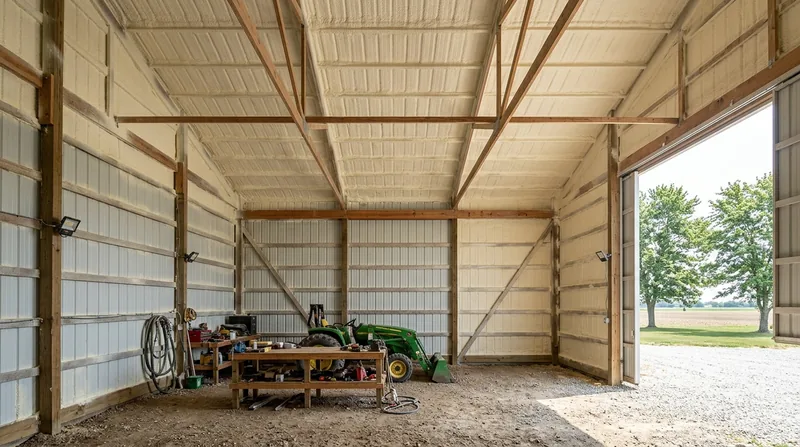




Metal building and barndominium spray foam insulation in Indianapolis stops the seasonal moisture swing that turns post-frame structures into condensation chambers. Boone County pole barns, Plainfield warehouses, and the barndominiums rising across Hamilton and Hendricks County all face the same climate reality: Indiana winters drop below zero while spring thaw pushes humidity up from the ground, and a steel skin with no thermal break sweats on the inside. Closed-cell spray foam seals the envelope, controls vapor drive, and holds an R-value that fiberglass or blown-in insulation cannot match in a metal building context. We have been spraying foam on post-frame shops, machine sheds, and sealed roof decks across Greater Indianapolis since 2012, and we size every job to the actual condensation risk, not the sales pitch.
Why Metal Building and Barndominium Insulation Matters in Indianapolis and Surrounding Counties
A metal building without insulation is a thermal battery: it heats up fast in summer and cools down fast in winter, and the temperature swing on the steel skin creates a dew point where moisture condenses on the inside. In Indianapolis and the farmland belt north and west, post-frame construction dominates because it is fast and economical, but the open truss bays and ribbed steel skins that make it cheap also make it a moisture trap. Spring thaw pushes groundwater vapor up through the concrete floor or dirt, the warm air inside meets the cold steel overhead, and you get rust staining on the inside of the roof panels, water damage to stored equipment, and structural decay that can cost tens of thousands to repair. Closed-cell foam stops that cycle by creating a continuous thermal and vapor barrier on the inside of the steel skin.
- Closed-cell foam creates a thermal break and a vapor barrier in one pass, preventing condensation from forming on the underside of the steel skin.
- The R-value holds year-round, unlike fiberglass batts that settle and lose performance in open truss bays.
- Sealed foam stops air infiltration at the rim, band joist, and roof-to-wall interface where convection losses are steepest.
- A 2 to 3 inch closed-cell installation typically reaches R-12 to R-18, enough to shift the dew point above the inside surface even in January.
Barndominiums and converted pole barns in Boone, Hendricks, and Shelby County also need this protection because they are lived in, not just stored in. A 1,200 square foot pole barn turned into a residence with no insulation will cost a fortune to heat in winter and be uninhabitable in summer.
Key info: A post-frame machine shed or pole barn in Boone County or Plainfield typically has 30 to 50 feet of unbroken roof span with no attic or floor cavity. Fiberglass or blown-in insulation cannot be mechanically fastened to the underside of corrugated steel without creating a vapor trap. Closed-cell foam adheres directly to the metal, cures in place, and handles the seasonal vapor drive that kills other materials.
How We Spray Foam Metal Buildings and Barndominiums in Indianapolis
The job starts with a site walk to measure the building footprint, identify the roof pitch and truss spacing, and assess moisture risk. We check for existing leaks, standing water, or rust damage that must be repaired before foam is applied. We never spray over a wet or compromised substrate because the foam will not cure properly and will trap moisture underneath. Once the site is dry and prepped, we stage equipment, run mechanical ventilation, and spray the closed-cell foam in controlled passes from the ridge down, maintaining the manufacturer ratio and drum temperature throughout. The foam rises and cures in place, bonding to the steel and creating a monolithic thermal and air barrier. After cure, we inspect for voids and thickness compliance, then verify the R-value and board footage on the invoice.
- We measure the building on site and calculate the square footage of roof deck, wall cavities, and rim joist areas that need coverage.
- We remove any old insulation, rodent nests, or debris that would interfere with foam adhesion and curing.
- We spray closed-cell foam in 1.5 to 2 inch passes, allowing each pass to cure before the next, ensuring density and R-value uniformity.
- We run continuous mechanical ventilation during application and cure to control VOC off-gassing and maintain air quality.
- We provide a written estimate that specifies the R-value, foam thickness, board footage, and re-entry window before the building is occupied.
A typical 40 by 60 foot pole barn roof deck takes 2 to 3 days to spray, cure, and inspect. Larger commercial shells or barndominiums with finished living space may take longer depending on access and the number of interior walls or knee walls that need sealing.
Example: A Whitestown barndominium with a 1,600 square foot open-plan great room under a 12/12 roof pitch needed 4 inches of closed-cell foam on the roof deck, 2 inches in the rim joist, and 1.5 inches in the knee wall cavities. The total was 2,100 board feet, reaching R-24 overhead and R-12 in the walls. The job took 3 days, cure time was 48 hours, and the owner moved in the following week. See our closed-cell spray foam page for more on how R-value and thickness work together.
| Approach | Description | Best For |
|---|---|---|
| Closed-cell foam on roof deck | 2 to 4 inches sprayed directly to the underside of corrugated steel or standing-seam metal roof. Reaches R-12 to R-24 and stops condensation by shifting the dew point above the inside surface. | Post-frame barns, machine sheds, and barndominiums where moisture control and thermal performance are critical. |
| Closed-cell in rim and band joists | 1.5 to 2 inches of closed-cell foam in the rim joist cavity where the building frame meets the concrete foundation. Creates a thermal break and air seal that stops convection loss and infiltration. | Barndominiums on slabs or crawl spaces, and post-frame buildings with finished living space on the ground floor. |
| Closed-cell in wall cavities | 1.5 to 2 inches sprayed into the cavities between the interior frame and the metal skin. Fills voids, eliminates air leakage, and provides thermal resistance where open-frame barns have exposed stud bays. | Barndominiums with living space, converted pole barns, and commercial metal buildings where interior walls or partitions need insulation. |
| Full-envelope closed-cell system | Roof deck, walls, rim joist, and any knee walls or attic cavities sealed with closed-cell foam in a single coordinated spray. Typical thickness 2 to 3 inches, achieving R-18 to R-30 overall. | New barndominiums, high-performance agricultural buildings, and commercial shells in Plainfield, Whitestown, or Boone County warehouses. |
Metal Building and Barndominium Spray Foam Cost in Indianapolis: What to Expect
Closed-cell spray foam on a metal building roof deck typically runs from $1.75 to $3.50 per square foot, depending on thickness, building size, and site access. A 2,400 square foot pole barn roof with 2 inches of closed-cell foam will cost roughly $4,200 to $8,400 before any wall or rim joist work. Larger commercial shells or barndominiums with multiple sealed cavities and higher R-value targets will be on the higher end of that range. The single largest cost driver is thickness and R-value: every additional inch of foam adds material and labor, and reaching R-24 instead of R-12 means doubling the thickness and roughly doubling the cost per square foot.
Site access and roof pitch also matter. A simple gable roof on a 40 by 60 barn is faster to spray than a complex roof with valleys, dormers, or skylights. Buildings in Boone County on rural sites with easy equipment access cost less per board foot than a tight residential lot in Carmel or Fishers where the rig must be positioned carefully. Existing insulation or contamination that must be removed before foam is applied adds labor and disposal fees.
We always provide a written estimate that specifies R-value, thickness, and board footage, so you know exactly what you are paying for. If you want to compare costs, get 2 or 3 estimates from different contractors and make sure each one lists the same R-value and thickness. A suspiciously low estimate with no R-value or thickness detail is a red flag. See our pricing page for typical ranges and what moves the cost up or down.
What to Look for When Hiring a Spray Foam Insulation Contractor Near Indianapolis
Spray foam is a chemical product that must be applied correctly or it will not cure, will off-gas, will not hold R-value, and will trap moisture. A bad spray foam job is often invisible until months later when the smell does not fade or the condensation comes back. When you are vetting a contractor, ask the right questions and verify the answers before you sign a contract.
- Ask for a written estimate that includes R-value, foam thickness in inches, total board footage, and the re-entry window before the building is occupied.
- Verify that the contractor is fully insured and ask for a certificate of insurance that names the spray foam work and your property as additional insured.
- Check references from similar jobs: a pole barn, a barndominium, or a metal building in Indianapolis or nearby counties where the contractor has done closed-cell work.
- Ask whether the contractor will run mechanical ventilation during application and cure, and what the timeline is from spray to re-entry.
- Confirm that the contractor understands the local building code for thermal barriers and ignition barriers, and whether a permit is required at your address.
- Avoid any contractor who promises immediate re-entry, who cannot explain the manufacturer ratio or drum temperature, or who quotes a price per board foot with no thickness or R-value attached.
If your metal building or barndominium is in a master-planned community or HOA in Carmel, Westfield, or Zionsville, check the architectural guidelines before you start. Most HOA rules do not touch interior insulation, but some do govern the color or finish of exterior spray foam if it is visible from the street. Call us at (463) 285-8584 and we can help you navigate what applies at your address and connect you with the local building department if needed. See our contact page to request a free estimate and ask any questions about your specific project.
Metal Building & Barndominium Spray Foam in Indianapolis: Pricing Guide
| Service | Price | Details |
|---|---|---|
| Closed-cell foam on roof deck | Starting at $1.75/sq ft | Two inches of closed-cell foam sprayed to metal roof deck, reaching R-12 to R-14. Cost varies with roof pitch, building size, and equipment access |
| Full-envelope metal building or barndominium | Starting at $2.50/sq ft | Roof deck, walls, rim joist, and knee walls sealed with closed-cell foam in a coordinated spray. Typical 2 to 3 inches, R-18 to R-30 |
| Rim joist and band joist sealing | Starting at $8/linear foot | 1.5 to 2 inches of closed-cell foam in the rim cavity where frame meets foundation. Includes air sealing and thermal break |
| Insulation removal and replacement | On estimate | Removal of old fiberglass, blown-in, or failed foam, plus new closed-cell spray. Site condition and contamination determine final cost |
| Commercial or large-scale project | On estimate | Warehouses, distribution centers, or barndominiums over 5,000 square feet require on-site measurement and moisture assessment |
| Free estimate | No charge | Site visit, written estimate with R-value and thickness, response within 24 hours at (463) 285-8584 |
Indicative pricing, the exact cost depends on square footage, finish, and site access. Free personalized estimate within 24h at (463) 285-8584.


