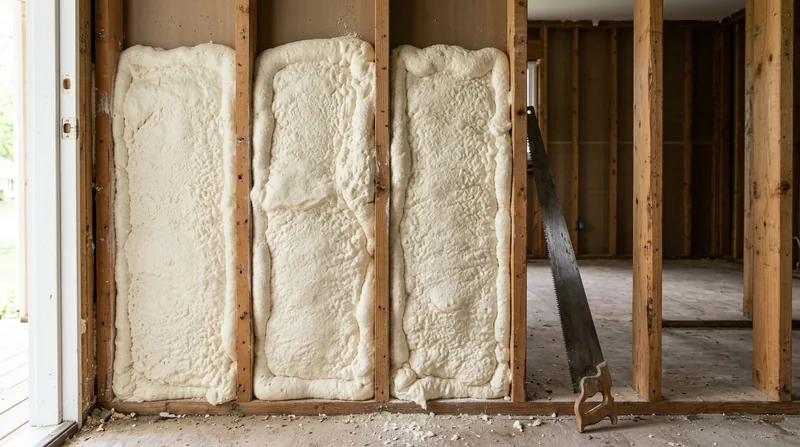




Open Cell Spray Foam Insulation in Indianapolis addresses the core problem that flat-roofed attics face in climate zone 5: uncontrolled heat loss in winter and vapor drive in summer, compounded by the thin original insulation in homes built before 1980 across the city's neighborhoods from Irvington to Carmel. Indianapolis sits on the central Indiana till plain where homes split between the balloon-framed Victorians and worker cottages inside the loop, the foursquares and bungalows of Broad Ripple and Meridian-Kessler, and the sprawling ranch and two-story subdivisions of Carmel, Fishers, Westfield, and Noblesville. Attics bake at 130 to 150 degrees Fahrenheit in July and drop below zero in January, making half-pound open-cell foam a cost-effective solution that air-seals at a friendlier price per board foot than closed cell, while delivering sound dampening between rooms and the two halves of double-wall construction. We say plainly where open cell belongs and where a crawl space or metal building calls for closed cell instead. A sealed attic with spray foam stops ice dams, eliminates cold floors in upper stories, and brings HVAC efficiency back into the conditioned space where it works.
Why Open Cell Spray Foam Matters in Indianapolis Attics and Walls
Indianapolis winters produce sub-zero nights and frozen pipes in crawl spaces, while summers push 90 degrees Fahrenheit with humidity that reverses vapor drive twice a year. Open-cell foam handles both because it breathes: it air-seals the attic envelope while allowing the wood structure underneath to manage moisture without trapping it. The older neighborhoods like Irvington, Fletcher Place, and Herron-Morton Place hold 1870s to 1920s balloon-framed Victorians with empty wall cavities and knee walls that build ice dams every winter. The post-war ranches of Lawrence, Speedway, and Beech Grove carry flattened original insulation and cold floors. Newer subdivisions in Hamilton County and Hendricks County have vaulted great rooms and bonus rooms that lose heat faster than standard attics. Open-cell foam fills all these cavities, seals air leaks, and does not require a vapor barrier because the foam itself is vapor-open.
- Open-cell foam air-seals attics and eliminates convection losses that fiberglass cannot stop.
- Sound dampening between rooms and the two halves of double-wall construction comes standard with the product.
- Half-pound density costs less per board foot than closed cell, making it the right choice for attic retrofits on sound structures.
- Vapor-open design prevents moisture traps in climate zone 5 where humidity flips with the seasons.
- Works in vaulted ceilings, knee walls, and rim joists where fiberglass batts leave gaps.
Getting the right insulation type depends on the use case, not the marketing budget, and we walk homeowners through that choice.
Key info: Indianapolis building code requires a thermal barrier on spray foam inside the attic if the foam is more than 1.5 inches thick. The fifteen-minute thermal barrier is a drywall or mineral fiber layer that sits between the foam and the living space below. Your local building department enforces this, not us. We help navigate what applies at your address and handle the installation per code.
For more on sealed attic design, see our closed cell spray foam page, which covers the high-R-value option for crawl spaces and metal buildings where condensation control is the priority.
How We Install Open Cell Spray Foam in Indianapolis Homes
The process starts with a walk-through to measure the attic, identify air leaks, check for wet substrates or active leaks, and establish what R-value and thickness the space needs. We draft a written estimate with R-value and thickness specs so you know exactly what you are paying for. If the roof is leaking or the attic has moisture, we walk away and refer you to the roofer first. Once the substrate is sound and dry, we set up mechanical ventilation, mask off the work area, and spray the foam in controlled passes, maintaining the manufacturer ratio and drum temperature. Open-cell foam cures in four to eight hours; we observe a re-entry window of twenty-four to forty-eight hours before the space is fully safe for occupancy. The smell is strong during cure but fades rapidly once ventilation runs and the foam off-gases.
- We inspect the attic, check for leaks, and measure the space to calculate board feet and R-value needed.
- We provide a written estimate with thickness in inches and final R-value before any work starts.
- We set up mechanical ventilation during spray and cure to manage VOC release and control the work environment.
- We spray in multiple thin passes rather than one thick pass, ensuring uniform density and proper rise.
- We observe the manufacturer re-entry window and advise you when the attic is safe for storage or access.
The whole process is transparent and follows the same rigor whether you are in Indianapolis, Carmel, or Greenwood.
Example: A 1950s ranch in Beech Grove with a 1,200-square-foot attic and R-11 batts in place gets open-cell spray foam at 5.5 inches, bringing the attic to R-23. The job takes one day, the smell clears in 48 hours, and the attic stays dry because the foam is vapor-open and the roof flashing is sound. Cost runs from $2,000 to $3,200 depending on access and eave cavity fill.
For more on air sealing and the details of how we close gaps around rim joists and band joists, see our air sealing page.
| Approach | Description | Best for |
|---|---|---|
| Open-cell spray foam (half-pound) | Low-density foam sprayed at 5 to 6 inches in attics and walls. Vapor-open, sound-dampening, lower cost per board foot than closed cell. Requires a thermal barrier if more than 1.5 inches thick. | Attic retrofits, knee walls, bonus rooms, and interior walls where sound control and cost matter more than extreme R-value. |
| Top-up with open-cell foam | Spray 2 to 4 inches of open-cell foam over existing fiberglass batts to raise R-value and seal air leaks without full removal. Cheaper than a complete retrofit. | Attics with sound insulation in place but inadequate R-value or visible air leaks around penetrations and eaves. |
| Closed-cell spray foam (two-pound) | High-density foam with high R-value per inch, vapor-closed, and condensation-resistant. Requires a thermal barrier if more than 1.5 inches thick. Higher cost per board foot. | Crawl spaces, metal buildings, rim and band joists, and sealed attics where vapor control and maximum R-value per inch are the priority. |
| Insulation removal and replacement | We remove failed, wet, or contaminated insulation and replace it with spray foam. Includes disposal and site cleanup. | Attics with water damage, settled fiberglass, rodent contamination, or foam that has off-gassed or lost R-value. |
Open Cell Spray Foam Insulation Cost in Indianapolis: What to Expect
Open-cell spray foam starts at around $0.55 per board foot in the Indianapolis market, though the final price depends on attic size, access, whether you are topping up or doing a full removal and replacement, and the R-value target. A 1,000-square-foot attic at 5.5 inches of open-cell foam (roughly R-23) runs approximately 5,500 board feet, putting the material cost in the range of $3,000 to $4,200 before labor and equipment. Labor typically adds another $1,500 to $2,500 depending on complexity and whether we remove old insulation first. Crawl spaces and rim joists cost less because the area is smaller, while bonus rooms and vaulted ceilings cost more because access is harder and the spray pattern is irregular.
The best way to lock in a realistic number is to get two or three written estimates with R-value and thickness spelled out. We provide a free estimate within 24 hours at (463) 285-8584, with no obligation to book. For a detailed pricing overview and examples by job type, see our pricing page.
Factors that move the cost up include removal of existing insulation (adds $800 to $1,500), difficult attic access (adds labor), and the need to spray around obstructions like HVAC ducts and plumbing vents. Factors that lower it include a clean, accessible attic and a top-up over sound fiberglass rather than a full tearout. Permits are required in some Indianapolis jurisdictions and handled through the local building department; we help you navigate what applies at your address.
What to Look for When Hiring a Spray Foam Insulation Contractor Near Indianapolis
Not all spray foam work is equal. The difference between a local shop that measures twice and sprays once, and a rig-and-run outfit that sprays in an afternoon and disappears, shows up in the smell, the cure time, and whether your attic stays dry. The difference between a contractor who reads the code and one who does not shows up in whether your insulation is legal and whether the foam will off-gas safely. Here is what to verify before you sign a contract.
- Ask for a written estimate with R-value and thickness in inches, not a vague price per square foot or a number with no specs.
- Confirm the contractor is fully insured and ask to see the certificate; verify the policy covers spray foam work and liability.
- Check references from recent jobs in Indianapolis or the surrounding towns, and call them to ask about the smell, the cure time, and whether the contractor was responsive after the job.
- Ask how the contractor handles mechanical ventilation during cure and what re-entry window they observe; correct answers are mechanical fans during spray and 24 to 48 hours before occupancy.
- Confirm the contractor understands the thermal barrier rule for your address and will include it in the estimate if required by code.
- Verify the contractor will inspect the attic for leaks and moisture before spraying; if they say they will spray over a wet substrate, walk away.
Getting multiple estimates is not just smart, it is the only way to spot the outliers and the scams. A price far below market with no inspection, no written specs, and a promise to re-enter the attic immediately are the clearest red flags. For a free estimate and a chance to ask questions, call us at (463) 285-8584 or request a free estimate online. We have been in business since 2012 and work year-round across Indianapolis, Carmel, Fishers, Noblesville, Westfield, Zionsville, Greenwood, Avon, and the surrounding areas.
Open Cell Spray Foam Insulation in Indianapolis: Pricing Guide
| Service | Price | Details |
|---|---|---|
| Open-cell spray foam, attic retrofit | Starting at $0.55/board ft | Material cost for half-pound foam; labor and equipment add $1,500 to $2,500 depending on attic size and access complexity |
| Top-up over existing fiberglass | Starting at $0.55/board ft | Spray 2 to 4 inches over sound batts; cheaper than full removal because no tearout labor or disposal cost |
| Full removal and replacement | Starting at $0.55/board ft plus removal | Includes tearout of old insulation, disposal, and new spray foam; adds $800 to $1,500 for removal labor and haul-away |
| Crawl space or rim joist open-cell foam | Starting at $0.55/board ft | Smaller area than attic, so total cost runs $800 to $1,800; access and moisture condition determine final price |
| Estimate | Free | Written estimate with R-value and thickness specs provided within 24 hours; no obligation to book or sign |
| Travel | Included | No separate mileage or call-out fee in Indianapolis and surrounding service areas within 30 miles of the city |
Indicative pricing, the exact cost depends on square footage, finish, and site access. Free personalized estimate within 24h at (463) 285-8584.


