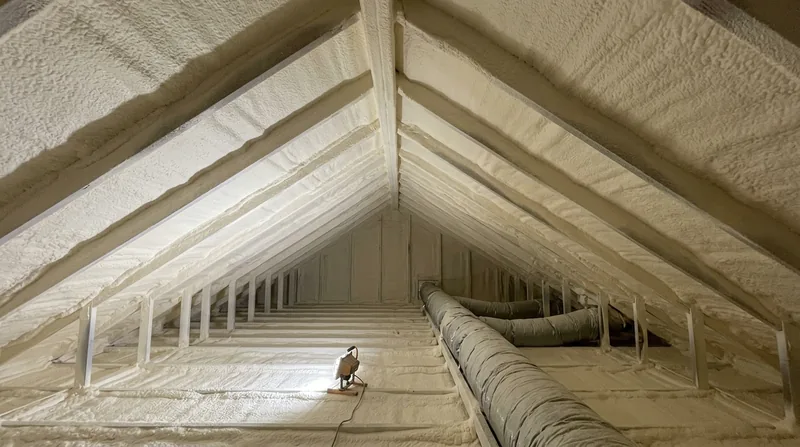




Indianapolis attics face a brutal climate: 140°F summer heat baking through flattened fiberglass, then sub-zero January nights when the same attic becomes a cold sink that pulls warmth from the rooms below. The city's stock splits between 1870s-1920s balloon-framed Victorians in Irvington, Fountain Square, and the Old Northside with empty wall cavities and finished half-story attics prone to ice dams; 1950s-60s ranches in Lawrence, Speedway, and Beech Grove with collapsed original insulation; and 1990s-2020s two-stories in Carmel, Fishers, Westfield, and Noblesville with vaulted great rooms and bonus rooms above garages that leak conditioned air into unconditioned space. Attic spray foam insulation in Indianapolis solves this by turning the attic into a sealed, conditioned envelope: open-cell foam on the roof deck stops the temperature swings, keeps ductwork inside the thermal boundary, and eliminates the ice dam cycle that has plagued Indianapolis homes for a century. Every estimate lists the R-value target, thickness per pass, and board footage so you know exactly what you are paying for.
Why Attic Spray Foam Insulation Matters in Indianapolis: The Ice Dam Problem and Energy Loss
Indianapolis winters flip the vapor drive twice a year. Humid summer air condenses on cold surfaces in winter, and in spring, meltwater from 130°F attics backs up under shingles because the attic temperature swings faster than the roof can shed it. Fiberglass insulation settles, compacts, and loses R-value; air leaks around rim joists, knee walls, and bypasses pull unconditioned air into the living space; and the attic becomes a thermal sieve. Spray foam on the roof deck seals the air leaks, maintains consistent R-value, and eliminates the temperature differential that creates ice dams.
- Stops ice dam formation by keeping the roof deck cold in winter, not warm from escaping attic heat.
- Seals air leaks around electrical penetrations, plumbing vents, and knee wall plates that fiberglass cannot reach.
- Moves the thermal boundary to the roof deck so ductwork, HVAC equipment, and supply lines stay inside the conditioned envelope.
- Maintains consistent R-value over decades without settling, unlike blown-in fiberglass that compresses under its own weight.
- Reduces strain on heating and cooling equipment by eliminating the temperature swings that drive energy demand.
The result is a stable attic environment that does not leak heat in January or draw cool air out of the house in July.
Key info: Indianapolis attics in Broad Ripple, Butler-Tarkington, and Meridian-Kessler with finished knee walls and half-story bedrooms suffer the worst ice dams because warm air from the living space rises into the half-attic, melts snow on the roof, and backs up under the shingles. Spray foam on the roof deck stops this cycle by keeping the roof deck below freezing all winter.
For more on how air sealing complements spray foam, see Air Sealing in Indianapolis. You can also check Indianapolis building code requirements at the City of Indianapolis Permits and Inspections page to understand what applies to your address.
How We Install Attic Spray Foam Insulation: From Estimate to Cure
The job starts with a walk-through to measure the attic, identify air leaks, check for moisture or contamination, and confirm that the substrate is sound. We calculate the board footage needed to reach your target R-value, specify the thickness per pass, and provide a written estimate with all three numbers. On install day, we set up containment, establish mechanical ventilation to manage VOC off-gassing, and spray the foam in controlled passes to ensure even coverage and proper density. After cure, we leave the attic sealed and tag all penetrations for drywall or other finishing work.
- We walk the attic with you, measure the square footage, and identify all air leaks and thermal bypasses that need sealing.
- We provide a written estimate that specifies the R-value target, foam thickness per pass, and total board footage.
- We set up negative pressure ventilation during spray and cure to manage off-gassing and keep the home safe.
- We spray the foam in controlled passes, allowing proper rise and density so the foam does not shrink or settle.
- We allow the manufacturer's cure window (typically 24 to 48 hours) before you re-enter the attic or run HVAC equipment.
- We document the job with photographs and a final walkthrough so you understand what was done and why.
This step-by-step approach is what separates a professional installation from a quick afternoon spray that leaves you with odor, poor coverage, or premature breakdown.
Example: A 1,800-square-foot attic in Carmel with a vaulted great room and bonus room above the garage might need R-38 to R-50 depending on whether the ductwork is inside or outside the foam boundary. At 4 inches of open-cell foam, that is roughly 600 board feet. We spray it in two passes of 2 inches each, allow full cure, and the attic goes from a 130°F summer furnace to a stable, conditioned space.
Learn more about the differences between foam types at Open Cell Spray Foam Insulation and Closed Cell Spray Foam Insulation.
Attic Spray Foam Insulation Methods and Approaches
| Approach | Description | Best for |
|---|---|---|
| Open-Cell Foam on Roof Deck | Low-density foam sprayed directly on the underside of roof sheathing, creating an air barrier and thermal boundary at the roof line. Allows the attic to be conditioned space. | Attics with ductwork, HVAC equipment, or finished half-story rooms. Most common in Indianapolis for sealed attics. |
| Closed-Cell Foam on Roof Deck | High-density foam with higher R-value per inch and vapor resistance. Used when space is tight or when moisture control is critical. | Attics with limited depth, metal roofs, or where vapor drive must be strictly controlled. |
| Open-Cell Foam Over Existing Insulation | Spray foam applied over settled fiberglass to restore R-value and seal air leaks without removing the old insulation. | Budget-conscious retrofits where the existing insulation is sound but has lost effectiveness and air sealing is the main goal. |
| Insulation Removal and Spray Foam Replacement | Complete removal of failed, settled, or contaminated insulation, followed by spray foam installation on a clean substrate. | Attics with significant moisture damage, rodent nesting, or collapsed insulation that cannot support a retrofit. |
Attic Spray Foam Insulation Cost in Indianapolis: What to Expect
Attic spray foam insulation in Indianapolis typically starts at $1.50 to $2.50 per square foot for open-cell foam on the roof deck, depending on the R-value target, attic access, and whether existing insulation must be removed first. A 1,500-square-foot attic with R-38 open-cell foam runs roughly $2,250 to $3,750 before any removal work. The final cost depends on several concrete factors: attic size and shape, how much of the roof deck is accessible, whether the substrate is clean or requires remediation, R-value target, and whether you are starting from bare decking or removing failed fiberglass first.
Closed-cell foam costs more per board foot because it delivers higher R-value in less space and offers superior vapor control. If your attic is tight or you need to seal a metal roof, closed-cell may be the right choice even at a higher price. The best way to understand what your job will cost is to get two or three written estimates that specify R-value, thickness, and board footage. This protects you from low-ball bids that skimp on coverage and ensures you are comparing apples to apples.
Cost drivers: Attic accessibility (low attic height, tight hatches, or rooftop access increases labor), existing insulation removal (adds $0.25 to $0.50 per square foot), substrate condition (moisture or contamination may require drying or cleaning before foam), and R-value target (R-38 costs less than R-50 because it requires fewer passes).
See our full pricing overview for detailed ranges, or contact us for a free estimate.
What to Look for When Hiring a Spray Foam Insulation Contractor Near Indianapolis
The spray foam trade has rig-and-run crews that spray in an afternoon and disappear when the smell will not go away, and it has national franchises that are hard to reach when something goes wrong. A local independent contractor should be your target. When you call, ask for a written estimate that includes R-value, thickness per pass, and board footage. Any contractor who gives you a price without those three numbers is guessing, and guessing is how bad jobs happen.
Verify that the contractor is fully insured and can provide a certificate of insurance on request. Ask about the cure window and re-entry time (should be 24 to 48 hours, not immediate). Check references from recent jobs in your neighborhood, Carmel, Fishers, or Noblesville so you can talk to people who know the contractor's work. If your home is in an HOA or historic district, confirm that the contractor understands any architectural or permitting rules that apply to your address. Finally, never pay the full price upfront; a 50 percent deposit and 50 percent on completion is standard and protects both of you.
- Get a written estimate with R-value target, foam thickness per pass, and total board footage specified in detail.
- Verify full insurance coverage and ask for a certificate of insurance before work begins.
- Ask about mechanical ventilation during spray and cure, and confirm the re-entry window is 24 to 48 hours minimum.
- Check references from recent jobs in your area so you can speak with homeowners who have used the contractor.
- Understand permit requirements for your city or neighborhood; the contractor should help you navigate what applies at your address.
- Never pay the full price upfront; a standard split is 50 percent deposit and 50 percent on completion.
A contractor who is transparent about process, insurance, and cost is far more likely to deliver a job you will be happy with for decades.
Ready to get started? Contact us for a free estimate or call (463) 285-8584 to discuss your attic and your goals.
Attic Spray Foam Insulation in Indianapolis: Pricing Guide
| Service | Price | Details |
|---|---|---|
| Open-Cell Foam on Roof Deck | Starting at $1.50/sq ft | Low-density foam to R-38 or R-50 depending on attic size and depth available for spray passes |
| Closed-Cell Foam on Roof Deck | Starting at $2.25/sq ft | High-density foam for tight attics or metal roofs where vapor control and R-value per inch matter most |
| Insulation Removal and Replacement | Starting at $2.00/sq ft | Complete tear-out of failed fiberglass or old foam plus new spray foam installation on clean substrate |
| Retrofit Over Existing Insulation | Starting at $1.25/sq ft | Spray foam applied over sound but settled fiberglass to restore R-value and seal air leaks without removal |
| Travel | Included | No separate mileage or travel fee within Indianapolis and all surrounding service areas |
| Free Written Estimate | No charge | Includes R-value target, thickness per pass, board footage, and cost range with no obligation to hire |
Indicative pricing, the exact cost depends on square footage, finish, and site access. Free personalized estimate within 24h at (463) 285-8584.


