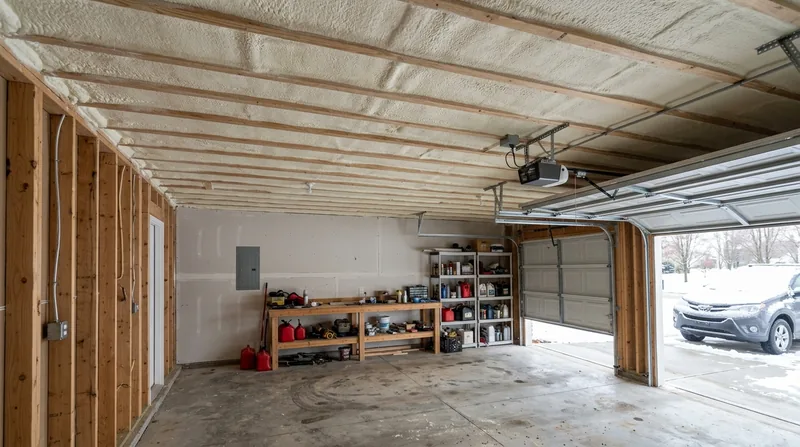




Garage spray foam insulation in Indianapolis transforms a storage box into usable space year-round, sealing ceilings under bonus rooms and shared walls against July heat that climbs to 130-150°F and sub-zero nights that drop below freezing. The flat terrain and sprawling subdivision belts of Carmel, Fishers, Westfield, Noblesville, and Zionsville are packed with 1990s-2020s two-stories built over crawl spaces and basements, many with three-car garages topped by bonus rooms, finished workshops, or vaulted great rooms. Without proper air sealing and insulation, those garage ceilings become thermal chimneys in winter and heat sinks in summer, bleeding conditioned air and driving up utility bills. Indianapolis climate zone 5 means real cold followed by humid summers, so vapor drive flips with the seasons and every assembly has to handle both. The difference between a storage box and a comfortable, temperature-stable space is closed cell or open cell foam applied to the ceiling and perimeter walls, sealed tight against the conditioned space above.
Why Garage Spray Foam Insulation Matters in Greater Indianapolis
Garages under bonus rooms and finished space are the weak link in most newer Indianapolis homes. The garage ceiling is the only thing separating conditioned air from an unconditioned buffer, and if that ceiling is not sealed and insulated, you lose money every month. In Carmel and Fishers, where three-car garages are standard and bonus rooms sit directly above, the thermal bypass is immediate and expensive. In older Speedway, Lawrence, and Beech Grove ranches, attached garages were never insulated at all, and the shared wall between garage and living space is a cold bridge in January. Workshop conversions, detached garages used as studios or hobby spaces, and climate-controlled storage all face the same problem: uncontrolled temperature swings and high heating and cooling costs.
- Seal the garage ceiling against conditioned space above, stopping heat loss in winter and heat gain in summer.
- Insulate shared walls between garage and living areas to eliminate cold drafts and condensation.
- Control humidity and moisture in workshop conversions and hobby spaces that see heavy seasonal use.
- Maintain consistent temperature in climate-controlled storage and specialty spaces without running HVAC into the garage.
Getting the garage envelope right is the foundation of any bonus room or finished garage project, and spray foam is the fastest way to do it right.
Key info: Indianapolis building code requires a thermal barrier between unconditioned and conditioned space. A garage ceiling under a bonus room must meet R-value and air sealing standards. We handle the insulation and air sealing; verify local permitting requirements with your city or county building department before work begins.
How We Insulate and Air Seal Garage Ceilings in Indianapolis
The job starts with a site visit to measure the ceiling area, assess the framing, identify thermal bypasses, and determine whether closed cell or open cell foam is the right choice. Closed cell is denser, higher R-value per inch, and vapor-impermeable, making it the standard for garage ceilings where moisture control and structural strength matter. Open cell is lighter, more affordable, and sound-dampening, but lower R-value per inch and vapor-permeable, so it works best in dry climates or as a secondary layer. We then prepare the space, protect HVAC ducts and electrical runs, and spray the foam in controlled passes, building thickness gradually to the specified R-value and thickness. Mechanical ventilation runs during cure, and we establish a re-entry window of twenty-four to forty-eight hours before the space is safe to occupy.
- Visit the site, measure the ceiling and walls, and verify local building code requirements for your address.
- Prepare the space by protecting ducts, electrical runs, and adjacent areas from overspray.
- Apply spray foam in controlled passes, building to the specified R-value and thickness per the written estimate.
- Install mechanical ventilation during cure to manage VOC release and ensure safe re-entry.
- Inspect the finished work, confirm uniform coverage and thickness, and provide written documentation.
A typical garage ceiling in a Fishers or Carmel bonus room runs 400 to 600 square feet and takes one to two days, depending on complexity and framing obstacles.
Example: A 500-square-foot garage ceiling under a finished bonus room in Westfield requires 3 to 5 inches of closed cell foam to reach R-18 to R-30, sealing the ceiling and all rim joists where the garage walls meet the house. The job takes one day. Mechanical ventilation runs for 24 hours, and the bonus room is usable the next morning.
For more on closed cell versus open cell performance and cost, see our guide to closed cell spray foam insulation in Indianapolis.
Garage Insulation Methods and Materials
| Approach | Description | Best for |
|---|---|---|
| Closed Cell Spray Foam | Dense, rigid foam at 3.5 to 3.6 lb/ft3, R-6.5 to R-7 per inch, vapor-impermeable, structural contribution. | Garage ceilings under conditioned space, shared walls, moisture-prone areas, bonus rooms in Carmel and Fishers. |
| Open Cell Spray Foam | Light, flexible foam at 0.5 to 0.6 lb/ft3, R-3.6 per inch, vapor-permeable, sound-dampening. | Workshop conversions, detached garages, hobby spaces where cost and sound control matter more than structural strength. |
| Closed Cell + Air Sealing | Foam applied to ceiling and rim joists, all thermal bypasses sealed, written estimate with R-value and thickness. | Complete garage envelope retrofit, new construction bonus rooms, climate-controlled storage in Indianapolis and suburbs. |
| Partial Retrofit | Foam applied to ceiling only, leaving walls uninsulated, lower cost, partial thermal control. | Tight budgets, garage used only for parking, where full envelope sealing is not justified. |
Closed cell is the standard for garage ceilings in Indianapolis because the combination of R-value, vapor control, and structural strength justifies the cost. Open cell works for detached spaces and workshops where budget is the constraint.
Garage Spray Foam Insulation Cost in Indianapolis: What to Expect
Garage spray foam insulation in Indianapolis starts at $1,200 to $2,500 for a typical 400 to 600 square foot ceiling under a bonus room, depending on foam type, thickness, access, and whether the job includes shared walls. Closed cell runs higher per board foot than open cell, but delivers higher R-value per inch and better moisture control, so the total cost per square foot is often comparable when you factor in thickness needed. A 500-square-foot garage ceiling in Fishers or Carmel requiring 3 to 4 inches of closed cell to reach R-24 to R-28 typically falls in the $1,800 to $2,200 range. If the job includes the shared wall between garage and living space, add another 100 to 200 square feet of wall area, which moves the total to $2,200 to $2,800. Partial retrofits (ceiling only, no walls) run lower; full envelope seals (ceiling plus all rim joists and shared walls) run higher.
The biggest factors affecting cost are foam type (closed cell versus open cell), thickness (driven by R-value target), ceiling area, framing complexity, and whether existing insulation must be removed first. A site visit with measurements and a written estimate with R-value and thickness specifications is the only way to lock in a real number. We provide free estimates within 24 hours at (463) 285-8584, and the estimate includes all factors specific to your address and building code.
For detailed pricing across all garage and bonus room scenarios, see our full pricing overview.
Garage Spray Foam Insulation Near Me: What to Look for When Hiring a Contractor in Indianapolis
Hiring the right spray foam contractor matters because bad installation (wrong ratio, low pressure, no ventilation, immediate re-entry promised) leaves you with smell, off-gassing, and wasted money. The trade has rig-and-run crews from out of state who spray a job in an afternoon and disappear, and national franchises with high overhead and no local accountability. A local independent contractor is positioned to deliver honest guidance and stand behind the work. When you call, ask for a written estimate that includes R-value and thickness specifications, not just a dollar figure. Verify that the contractor carries full insurance and can provide a certificate of insurance on request. Ask for references from recent jobs in Indianapolis, Carmel, or Fishers, and call them. Understand what your city or county building department requires for permits and inspection, and confirm that the contractor will help you navigate those requirements. If your property is in an HOA with architectural rules (common in Zionsville, Westfield, and Avon), verify that exterior work does not trigger approval requirements.
- Get a written estimate that specifies R-value, foam thickness in inches, and the area being insulated.
- Verify full insurance coverage and request a certificate before work begins.
- Ask for at least two references from similar jobs completed in the past 12 months.
- Confirm that the contractor understands local building code and permitting for your address.
- Understand the re-entry window (typically 24 to 48 hours) and ventilation plan during cure.
- Check that the estimate includes air sealing of rim joists, band joists, and thermal bypasses, not just the ceiling.
The strongest signal of a qualified contractor is a detailed estimate with R-value and thickness, controlled installation with documented ventilation, and willingness to put the work in writing with a clear re-entry window. For a free estimate from a local Indianapolis contractor, contact us today.
When to Schedule Garage Insulation in Indianapolis
Spray foam insulation can be applied year-round in Indianapolis, but timing affects how quickly you notice the benefit. If you are finishing a bonus room or converting a garage to a workshop, schedule the insulation before drywall and flooring go in, so the foam is in place and cured before you occupy the space. In winter, the job is urgent because an uninsulated garage ceiling bleeds heat into an unconditioned buffer, wasting money every cold night. In summer, the thermal load is just as real: a garage ceiling with no insulation lets 130+ degree attic heat radiate into the bonus room above, forcing your air conditioning to run harder. Fall and spring are the easiest times to schedule because outdoor temperatures are moderate and ventilation during cure is straightforward. We work year-round, and the job itself takes one to two days regardless of season. The key is getting it done before the next heating or cooling season hits.
Whether you are in Indianapolis, Carmel, Fishers, Noblesville, or Westfield, the climate zone 5 reality is the same: your garage ceiling is either sealed and insulated, or it is bleeding money. Call (463) 285-8584 for a free estimate and let us show you the difference.
Garage Spray Foam Insulation in Indianapolis: Pricing Guide
| Service | Price | Details |
|---|---|---|
| Garage ceiling, typical (400-600 sq ft) | Starting at $1,200 | Closed cell foam, 3-4 inches, R-20 to R-28, sealed against conditioned space above |
| Ceiling plus shared wall retrofit | Starting at $1,800 | Garage ceiling plus shared wall with living space, 100-200 additional sq ft, full envelope seal |
| Workshop or detached garage conversion | Starting at $1,500 | Open or closed cell, climate-controlled space, depends on size, insulation depth, and access |
| Full garage envelope (ceiling, walls, rim joists) | On estimate | Large garages, complex framing, existing insulation removal, or bonus room with vaulted ceiling require site visit |
| Travel and site visit | Included | No extra charge for Indianapolis and surrounding service areas including Carmel, Fishers, Westfield, Noblesville |
| Free estimate | Free | Written estimate with R-value and thickness, response within 24 hours, no obligation to book |
Indicative pricing, the exact cost depends on square footage, finish, and site access. Free personalized estimate within 24h at (463) 285-8584.


