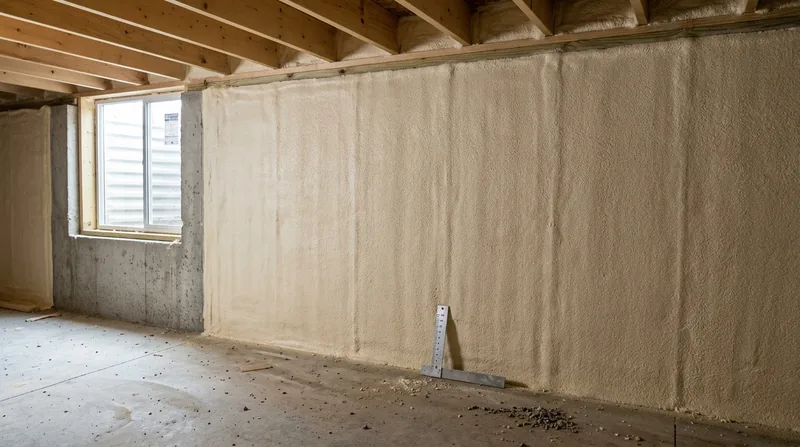




Closed cell spray foam insulation in Indianapolis is the engineering choice for crawl spaces, basement rims, pole barns, and any wall assembly that has to survive a sub-zero January and a humid August without sweating or failing. Two-pound closed-cell foam delivers R-6.5 per inch with its own vapor retarder and structural stiffening that open-cell cannot match. Indianapolis sits in climate zone 5 with real cold, real humidity swings, and a building stock that splits between 1870s balloon-frame Victorians with empty wall cavities, 1950s ranches on crawl spaces with failed original insulation, and new construction running vaulted great rooms and bonus rooms above three-car garages. Every assembly here has to handle both directions of vapor drive and both extremes of temperature. Closed-cell foam is the answer for the conditions that actually live in this city.
Why Closed Cell Spray Foam Matters in Indianapolis Crawl Spaces and Foundation Walls
Crawl spaces in Indianapolis are the single biggest failure point in the regional building stock. The 1950s and 1960s ranches that ring the city were built with vented crawl spaces and minimal insulation, and they sit on clay till that wicks moisture upward every spring. A vented crawl space in July hits 95 degrees and 95 percent humidity; in January it drops to 20 degrees and frost forms on rim joists and water lines. Fiberglass batts absorb that moisture, collapse, and stop working. Closed-cell foam seals the rim joist and band joist, stops the air leak, and acts as its own vapor retarder so moisture cannot condense into the cavity. The same logic applies to basement walls in older Indianapolis homes and to pole barns and barndominiums in Boone, Hendricks, and Johnson County where condensation on steel posts and metal skins is the dominant failure mode.
- Closed-cell foam delivers R-6.5 per inch, so three inches gives you R-19.5 on a crawl space rim without taking up the footprint of fiberglass batts.
- The foam itself is the air barrier and the vapor retarder, so you eliminate the separate poly layer and the tape-and-mud installation that fails.
- Crawl space walls sprayed with closed-cell foam stay dry because the foam does not absorb moisture and does not allow condensation to form behind it.
- Pole barn walls and metal building skins stop sweating because the foam controls the temperature difference that drives condensation.
- Basement rim joists and band joists sealed with closed-cell foam stop the cold air leak that makes basements feel like caves and keeps first-floor rooms drafty.
The result is a dry, conditioned rim joist, a dry crawl space, and a dry pole barn interior. That is the job closed-cell foam does in Indianapolis.
Key info: Indianapolis crawl spaces built in the 1950s-1970s are the regional standard, and every one of them will eventually face rim joist rot, water staining, and moldy fiberglass if left uninsulated. Closed-cell foam fixes the problem at the source by controlling air, temperature, and moisture all at once.
For more on crawl space insulation and how it differs from attic work, see our crawl space spray foam insulation page. The Indianapolis building department and your local city or township office can advise on any permits required for your specific address.
How We Install Closed Cell Spray Foam in Indianapolis: The Process
Closed-cell spray foam is applied as a liquid and expands to fill every cavity, crack, and corner. The installation is precise because thickness, application rate, and drum temperature all affect the final R-value and the structural properties of the foam. We start with a site walk to identify the substrate, check for moisture, and establish the scope. If the substrate is wet, contaminated, or actively leaking, we do not spray. We fix the moisture first or we walk away. Once the space is ready, we set up mechanical ventilation, mix the foam to the manufacturer ratio, and apply it in controlled passes to achieve the thickness and R-value your job requires. During cure, mechanical ventilation stays running. We do not allow re-entry until the manufacturer re-entry window is met, typically twenty-four to forty-eight hours depending on ambient temperature and humidity.
- We inspect the substrate for moisture, mold, or contamination before any foam is mixed or applied.
- We establish the target R-value and thickness for your application, documented in the written estimate.
- We set up mechanical ventilation to manage off-gassing during the cure cycle.
- We apply the foam in controlled passes, maintaining the manufacturer drum temperature and mix ratio throughout.
- We run ventilation for the full cure window and provide you with a re-entry timeline in writing.
- We document the final thickness and R-value on the job completion record.
This process takes longer than the rig-and-run crews who spray in an afternoon and disappear, but it is the only way to deliver a durable, code-compliant installation that will not smell bad, fail prematurely, or leave you with a mess to deal with.
Example: A Fishers crawl space with a wet rim joist and rotting sill plate requires the substrate to be dried and any rotted wood to be replaced before foam is applied. We do that work first, then spray the closed-cell foam to seal and insulate. A Carmel basement rim joist that is dry but uninsulated gets sprayed directly, typically three to four inches of closed-cell foam to achieve R-19 to R-26.
For a detailed walkthrough of our air sealing and insulation process, see our air sealing page.
Closed Cell Spray Foam Applications: Methods and Best Uses
| Application | Description | Best For |
|---|---|---|
| Crawl Space Walls | 2-3 inches of closed-cell foam sprayed directly onto the rim joist, band joist, and foundation walls. Acts as air barrier and vapor retarder. | 1950s-1970s Indianapolis ranches with vented crawl spaces and moisture problems. Stops rim joist rot and cold floors. |
| Basement Rim and Band Joists | 3-4 inches of closed-cell foam on the rim joist where it meets the foundation. Seals the thermal bridge and air leak. | Finished basements in Indianapolis, Carmel, and Westfield where first-floor rooms feel cold. Improves comfort and reduces heating load. |
| Pole Barn and Metal Building Walls | 2-4 inches of closed-cell foam sprayed on the interior of metal skins and wood posts. Prevents condensation on steel and controls interior temperature. | Post-frame barns, equipment sheds, and barndominiums in Boone and Hendricks County. Stops sweat in spring and frost in winter. |
| Wall Cavity Retrofit in Old Indianapolis Homes | Closed-cell foam injected into existing wall cavities of 1870s-1920s Victorians and balloon-frame cottages. No demolition required. | Irvington, Fountain Square, Fletcher Place, and other historic neighborhoods where the walls are empty and the siding is original. |
| Sealed Attic Roof Decks | Closed-cell foam sprayed on the underside of the roof deck to create a conditioned attic. Requires proper thermal barrier and ventilation per code. | New construction and major renovations where the attic will be used for storage or mechanical equipment. Premium performance in Indianapolis heat and cold. |
Closed Cell Spray Foam Insulation Cost in Indianapolis: What to Expect
Closed-cell spray foam is priced per board foot, which is one foot by one foot by one inch of foam. Starting rates in Indianapolis run from $1.20 to $1.50 per board foot, depending on the thickness, the size of the job, and the accessibility of the space. A crawl space rim joist on a 2,000-square-foot Indianapolis ranch typically runs 800 to 1,200 board feet of foam at 3 inches thick, which puts the material cost in the $960 to $1,800 range before labor. A pole barn wall on a 40-foot by 60-foot building at 3 inches thick runs 7,200 board feet, so material alone is $8,640 to $10,800. Labor, equipment, and overhead add another 40 to 60 percent to the material cost. The final number depends on whether the substrate is clean and dry, whether the space is easy to access, whether the job is one room or the whole house, and whether any substrate repair is needed before foam is applied.
The most common mistake is getting a price from a fly-by crew with no R-value, no thickness spec, and no written timeline. Get three estimates. Each one should specify the R-value you will receive, the thickness in inches, the total board feet, and the re-entry window. If an estimate has none of those, do not sign it. For a detailed pricing breakdown and to request a free written estimate, visit our pricing page.
Closed Cell Spray Foam Insulation Near Me: What to Look for When Hiring a Contractor in Indianapolis
Hiring a spray foam contractor is not the same as hiring a roofing or HVAC company. The work is specialized, the equipment is expensive, and the installation quality determines whether the foam works or becomes a liability. Start by asking any contractor for proof of current insurance coverage. Call the insurer to verify the policy is active. Ask for references from jobs in the last two years, and call at least two. Ask what their re-entry policy is and whether they will put it in writing. Ask whether they pull permits, and if so, which city or township. The permitting and registration regime for spray foam work varies from city to city across Greater Indianapolis, so the contractor should know your local requirements or be willing to help you verify them with your building department. Ask whether they use closed-cell or open-cell foam and why they are recommending one over the other. If they say both are the same, that is a red flag. Closed-cell is for moisture control and structural stiffening; open-cell is for sound dampening and cost savings on attics that are already ventilated. If the contractor cannot explain the difference, they do not understand the product.
- Verify the contractor is fully insured and ask for a certificate of insurance before work begins.
- Request written references from at least two jobs completed in the last 24 months and follow up with phone calls.
- Confirm the estimate includes R-value, thickness in inches, total board feet, and a re-entry timeline in writing.
- Ask whether the contractor will help you navigate local permits or whether that is your responsibility.
- Understand the difference between closed-cell and open-cell foam and why one is recommended for your specific application.
- Check for mechanical ventilation during cure and a stated re-entry window of at least 24 to 48 hours.
The local independent contractor with a local address and local plates is positioned against both the rig-and-run crews (an out-of-state trailer, a job sprayed in an afternoon, nobody reachable when the smell will not go away) and the national franchises that treat insulation as a commodity. Honest guidance is the differentiator. For a free, no-obligation estimate, contact us at (463) 285-8584.
Closed Cell Spray Foam Insulation in Indianapolis: Pricing Guide
| Service | Price | Details |
|---|---|---|
| Crawl Space Rim Joist Sealing | Starting at $1.20/board ft | Three inches of closed-cell foam on rim and band joists; price moves with joist length, accessibility, and substrate condition |
| Basement Rim Joist Insulation | Starting at $1.30/board ft | Three to four inches of closed-cell foam on foundation rim; cost varies by linear footage and whether any rotted wood must be replaced first |
| Pole Barn and Metal Building Walls | Starting at $1.20/board ft | Two to four inches of closed-cell foam on interior metal or wood surfaces; total cost depends on wall square footage and access for spray equipment |
| Wall Cavity Retrofit and Injection Foam | On estimate | Closed-cell foam injected into existing wall cavities requires site inspection to assess cavity depth, obstruction, and structural integrity before pricing |
| Travel and Estimate | Included and Free | No mileage fees in Indianapolis and surrounding areas; free written estimate with R-value and thickness specs within 24 hours of contact |
Indicative pricing, the exact cost depends on square footage, finish, and site access. Free personalized estimate within 24h at (463) 285-8584.


