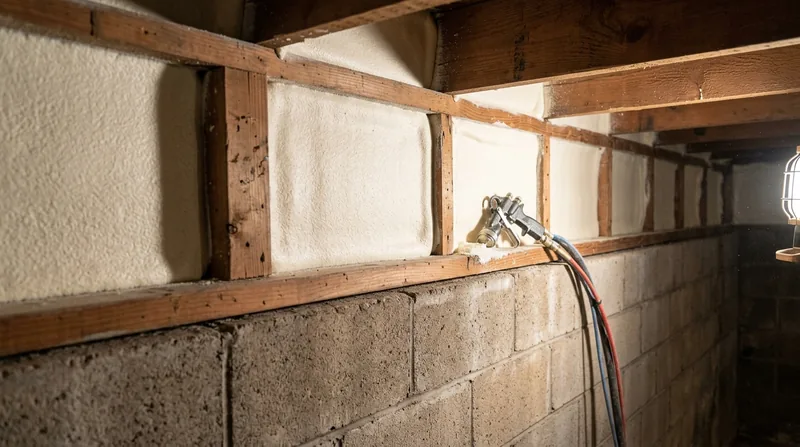




Rim joists and band joists leak more cold air than almost anything else in an Indianapolis house. These are the horizontal beams that sit on top of your foundation wall, wrapping around the perimeter where the basement or crawl space meets the framed walls above. In the flat central Indiana climate, where winter temperatures drop below zero and humidity swings from bone-dry heating season to wet summer air, that uninsulated rim joist becomes a thermal sieve. Rim joist and band joist spray foam seals every bay along the top of the foundation with closed cell foam, stopping the leak fast and delivering one of the quickest comfort paybacks in the house. This is the small-ticket job that often surprises homeowners with how much warmer the first floor feels.
Indianapolis spreads across the flat till plain, and its housing stock splits into two camps. Older homes inside the 465 loop, from Irvington to Fountain Square to the near north side, sit on full basements with rim joists that have never been sealed. Newer suburbs, from Carmel and Fishers north through Westfield and Zionsville, run crawl spaces and slab-on-grade, and their cantilevers and band joists get the same treatment. Either way, that rim joist is exposed to basement or crawl space air that in January is unheated and in July is humid. Closed cell foam stops both the cold leak and the moisture drive, and it does it in a single afternoon on most houses.
Why Rim Joist and Band Joist Sealing Matters in Indianapolis
The rim joist is where the house frame sits on the concrete foundation. It runs continuously around the perimeter, and in most Indianapolis homes built before 1990, it is either bare wood or covered only with siding, with no insulation in the rim joist bays at all. In January, when the basement sits at 40 to 50 degrees, the rim joist acts as a thermal bridge straight into the first-floor walls and rim cavity. You feel it as cold floors along exterior walls, and you see it in heating bills that stay high even after you insulate the attic. In summer, humid crawl space air moves into the rim joist cavity, and moisture condenses on the rim board itself, leading to wood rot if left alone.
- Cold floors along exterior walls in winter are often caused by an uninsulated rim joist pulling cold air from the basement or crawl space.
- Closed cell spray foam seals the rim joist in a single pass, stopping air movement and blocking moisture drive in both directions.
- The job takes two to four hours on a typical house, and the basement or crawl space does not need to be finished or climate-controlled first.
- Cantilevers, where a second story overhangs the first, get the same foam treatment and see the same benefit.
- The foam cures in place and requires no maintenance, and the rim board stays dry and sound for decades.
Sealing the rim joist is one of the fastest ways to improve first-floor comfort and protect the foundation wood from moisture damage.
Local example: A 1950s brick ranch in Speedway or Beech Grove with a vented crawl space will have a cold rim joist running the entire perimeter. Sealing it with closed cell foam stops the cold draft and prevents the moisture that causes rim board rot in the humid season. The job costs less than $2,000 on most 1,200-square-foot ranches and pays back in the first winter.
For more information on how closed cell spray foam works and its R-value performance, visit our detailed closed cell page.
How We Seal Rim Joists in Indianapolis Basements and Crawl Spaces
The rim joist sealing process starts with access. We enter the basement or crawl space and inspect the rim board, the rim joist cavity, and the band board above it. If the rim board is wet, soft, or actively leaking, we address that first or we walk away. Spray foam on a wet substrate fails. Once the rim is dry and sound, we mask off the area, set up mechanical ventilation to manage cure odor, and apply closed cell foam to fill every bay. The foam expands slightly and then cures hard, and we trim it flush with the rim board. The entire rim joist is now sealed, and air movement stops.
- We inspect the rim board for moisture, soft spots, or active leaks before any foam is applied.
- We set up mechanical ventilation during the spray and cure to manage odor and ensure safe air quality.
- We apply closed cell foam in controlled passes, holding the manufacturer ratio and gun temperature steady.
- We trim the cured foam flush with the rim and band board, leaving a clean finish and clear visibility of the sealed bays.
- We provide a written estimate with R-value, thickness, and board-foot coverage before we start.
The job is complete in one day, and the house is safe for normal occupancy after a twenty-four to forty-eight hour cure window.
Typical Indianapolis job: A Carmel or Fishers two-story with a vented crawl space under a 2,000-square-foot footprint has roughly 400 linear feet of rim joist. Sealing it with 1.5 inches of closed cell foam takes three to four hours and leaves the crawl space warmer and drier. See our crawl space spray foam page for how this ties into broader crawl space conditioning.
Rim Joist and Band Joist Sealing Methods
| Approach | Description | Best for |
|---|---|---|
| Closed Cell Spray Foam | 1.5 to 2 inches of closed cell foam sprayed into the rim joist bays. Expands slightly, cures hard, and seals the entire cavity in one pass. R-value of 6 to 7 per inch. | All rim joists, especially those exposed to unheated basements or humid crawl spaces. Best choice for moisture control and air sealing in one step. |
| Multiple Thin Passes | Spray foam applied in 0.75-inch passes, allowing each layer to cure before the next is applied. Gives better control over thickness and reduces odor per pass. | Occupied homes where cure odor is a concern, or rim joists with complex geometry or obstructions that require careful application. |
| Rim Joist with Cantilever Extension | Spray foam applied to rim joists plus the cantilevered portion where upper stories overhang the lower foundation. Treats the entire thermal bridge in one operation. | Two-story homes in Carmel, Fishers, Noblesville, and Westfield where cantilevers are common and cold floors upstairs are a complaint. |
| Rim Joist Plus Foundation Wall | Spray foam extends down the rim joist and onto the top portion of the foundation wall, sealing both the air leak and the thermal mass of the concrete. | Older Indianapolis homes with uninsulated basement walls and persistent cold floors. Increases R-value and comfort on the first floor. |
Rim Joist and Band Joist Spray Foam Cost in Indianapolis: What to Expect
Rim joist sealing is one of the lowest-cost spray foam jobs on the board. A typical Indianapolis home with 300 to 500 linear feet of rim joist runs from $650 to $1,500 depending on rim joist depth, access difficulty, and whether the job includes cantilevers. A 1,200-square-foot ranch on a crawl space costs less than a 2,500-square-foot two-story with a finished basement and tight access. The price also reflects whether the rim board needs repair or if moisture work is required first.
The biggest cost drivers are linear footage, rim joist depth in the bays, and whether you are sealing a simple perimeter or adding cantilevers and foundation wall sections. Travel is included in the estimate for all Indianapolis addresses and surrounding areas. Get two or three estimates before you book, and make sure each one specifies the R-value, foam thickness, and board-foot volume. A written estimate with those details is the mark of a professional shop. For a full breakdown of our pricing and how different jobs are quoted, see our pricing page.
What to Look for When Hiring a Spray Foam Contractor Near Indianapolis
Rim joist sealing is straightforward work, but it still requires the right equipment, training, and attention to detail. When you call contractors in Indianapolis, Carmel, Fishers, Noblesville, or any other area, ask these questions. First, ask if they inspect the rim board for moisture or rot before spraying. If they say no, keep looking. Second, ask if they use mechanical ventilation during cure and what re-entry window they recommend. If they promise immediate re-entry or deny any odor, they are cutting corners. Third, ask for a written estimate with R-value, thickness, and board-foot figures. A price with no specs is a guess, not a quote.
Check that the contractor carries full insurance and can provide a certificate on request. Ask for references from recent rim joist jobs in your area, and call at least one. Ask about permits. In Indianapolis and most surrounding areas, rim joist sealing does not require a permit, but verify that with your local building department if you have any doubt. If you have an HOA, check the rules for any exterior or basement work, though rim joist sealing rarely triggers architectural review. For a free estimate with no obligation, contact us at (463) 285-8584 and we will respond within 24 hours.
Rim Joist & Band Joist Spray Foam in Indianapolis: Pricing Guide
| Service | Price | Details |
|---|---|---|
| Rim Joist Sealing, Standard | Starting at $650 | 300 to 400 linear feet of rim joist, 1.5 inches closed cell foam, typical basement or crawl space access |
| Rim Joist with Cantilever | Starting at $950 | Rim joist plus cantilevered section, two-story homes, sealed thermal bridge from foundation to upper floor |
| Rim Joist Plus Foundation Wall | Starting at $1,200 | Rim joist extended down foundation wall 12 to 24 inches, increased R-value and moisture control on older homes |
| Complex or Large Scope | On estimate | Wet rim boards requiring repair, deep rim joist bays, multiple levels, or access restrictions require site inspection |
| Travel | Included | No separate mileage or call-out fee for Indianapolis and surrounding service areas within 30 miles |
| Estimate | Free | Written estimate with R-value, thickness, and board-foot specs, response within 24 hours at (463) 285-8584 |
Indicative pricing, the exact cost depends on square footage, finish, and site access. Free personalized estimate within 24h at (463) 285-8584.


